PUSHING 70, Professor Leo Tan has seen most of his dreams come true. Some were his own, others were thrust upon him.
He wanted to be the first Singaporean to graduate with a marine biology PhD from Singapore. And he did, against the odds. He spent 40 years fighting for the preservation of Labrador Park – Singapore’s only rocky coast – and succeeded. It was gazetted as a nature reserve in 2002. He spent the last six years canvassing for our very own natural history museum. It is slated to open by the end of this year at the National University of Singapore’s new University Town.
Along the way, he breathed life into the sleepy Singapore Science Centre, overhauled the teaching of science in schools, infected a generation of teachers at the National Institute of Education with his love of learning, and, as chairman of National Parks Board, championed Gardens by the Bay.
His former student, Professor Peter Ng, 54, director of the Raffles Museum of Biodiversity Research at NUS, says: “His is a world dominated by a very simple philosophy. Just do it if it is right. Never mind if it is difficult.”
Never mind that he may be just a footnote in history. For the upcoming Lee Kong Chian Natural History Museum, Prof Tan bears no official title, not even as patron or adviser, though he is widely hailed as its visionary.
As a schoolboy at St Joseph’s Institution, then in Bras Basah Road, he often visited the nearby Raffles Museum in Stamford Road, with its large natural history collection of mammal, bird and amphibian specimens. It was housed at the National Museum of Singapore until 1970, when the collection of animals and artefacts was thrown out to focus exhibits on art and ethnography.
Then a marine biology doctorate student, Prof Tan remembers making this solemn promise to himself: “If I could, one day, I’d like to restore the old Raffles Museum.”
The prized collection languished without a permanent home and in poor condition for years. But he never forgot it. He visited the dust-lined specimens in random storerooms through the years until, in 1998, part of the collection found a home at the Raffles Museum of Biodiversity Research, a research and teaching museum at NUS.
Not content with that, Prof Tan returned to the NUS faculty in 2008, after 26 years away, continuing his charge that Singapore’s oldest natural history collection had not been “returned to the people of Singapore” for public viewing.
He pushed through his idea for a natural history museum through sheer strength of will, by getting permission from NUS to raise funds. He and his team were given the near impossible target to raise $35 million in the aftermath of the 2009 financial meltdown. But he rationalised: “If I’ve done some near impossible things in the past, why not try?” Within six months, he helped raise $46 million from an anonymous donor, foundations and individuals.
Then three dinosaurs were offered to the museum, and he raised another $10 million for that and other exhibition costs. Now he is focused on trying to double the endowment fund to $100 million, from its current $50 million, to ensure the museum can sustain itself beyond the first three years.
He’s hard at work making sure the museum’s impact extends far beyond its walls. From next month, it will have a teaching lab and run courses for biology and other students at NUS. When it opens, it will have a volunteer outreach crew doing guided walks and leading discussions on how to have a sustainable Singapore, what its priorities and values are, what is worth preserving and how to create room for all.
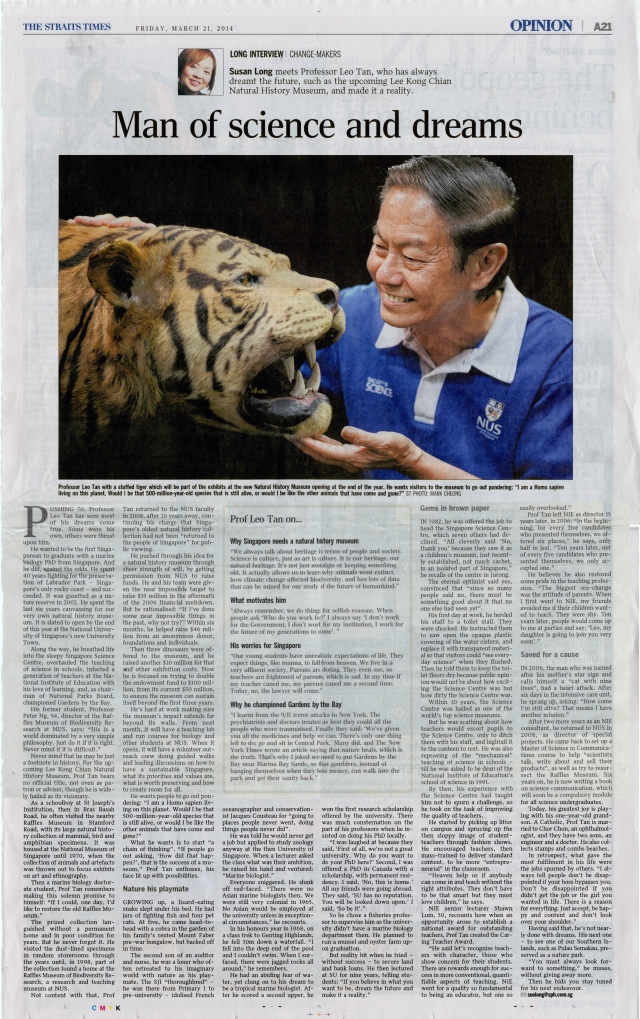
He wants people to go out pondering: “I am a Homo sapien living on this planet. Would I be that 500-million-year-old species that is still alive, or would I be like the other animals that have come and gone?”
What he wants is to start “a chain of thinking”. “If people go out asking, ‘How did that happen?’, that is the success of a museum,” Prof Tan enthuses, his face lit up with possibilities.
Nature his playmate
GROWING up, a lizard-eating snake slept under his bed. He had jars of fighting fish and four pet cats. At five, he came head-to- head with a cobra in the garden of his family’s rented Mount Faber pre-war bungalow, but backed off in time.
The second son of an auditor and nurse, he was a loner who often retreated to his imaginary world with nature as his playmate. The SJI “thoroughbred” – he was there from Primary 1 to pre-university – idolised French oceanographer and conservationist Jacques Cousteau for “going to places people never went, doing things people never did”.
He was told he would never get a job but applied to study zoology anyway at the then University of Singapore. When a lecturer asked the class what was their ambition, he raised his hand and ventured: “Marine biologist.”
Everyone sniggered. He slunk off red-faced. “There were no Asian marine biologists then. We were still very colonial in 1965. No Asian would be employed at the university unless in exceptional circumstances,” he recounts.
In his honours year in 1968, on a class trek to Genting Highlands, he fell 30m down a waterfall. “I fell into the deep end of the pool and I couldn’t swim. When I surfaced, there were jagged rocks all around,” he remembers.
He had an abiding fear of water, yet clung on to his dream to be a tropical marine biologist. After he scored a second upper, he won the first research scholarship offered by the university. There was much consternation on the part of his professors when he insisted on doing his PhD locally.
“I was laughed at because they said, ‘First of all, we’re not a great university. Why do you want to do your PhD here?’ Second, I was offered a PhD in Canada with a scholarship, with permanent residency. I said, ‘No, this is home.’ All my friends were going abroad. They said, ‘SU has no reputation. You will be looked down upon.’ I said, ‘So be it’.”
So he chose a fisheries professor to supervise him as the university didn’t have a marine biology department then. He planned to run a mussel and oyster farm upon graduation.
But reality bit when he tried – without success – to secure land and bank loans. He then lectured at SU for nine years, telling students: “If you believe in what you want to be, dream the future and make it a reality.”
Gems in brown paper
IN 1982, he was offered the job to head the Singapore Science Centre, which seven others had declined. “All cleverly said ‘No, thank you’ because they saw it as a children’s museum, just recently established, not much cachet, in an isolated part of Singapore,” he recalls of the centre in Jurong.
The eternal optimist said yes, convinced that “since so many people said no, there must be something good about it that no one else had seen yet”.
His first day at work, he herded his staff to a toilet stall. They were shocked. He instructed them to saw open the opaque plastic covering of the water cistern, and replace it with transparent material so that visitors could “see everyday science” when they flushed. Then he told them to keep the toilet floors dry because public opinion would not be about how exciting the Science Centre was but how dirty the Science Centre was.
Within 10 years, the Science Centre was hailed as one of the world’s top science museums.
But he was scathing about how teachers would escort pupils to the Science Centre, only to ditch them with his staff, and hightail it to the canteen to rest. He was also reproving of the “mechanical” teaching of science in schools – till he was asked to be dean of the National Institute of Education’s school of science in 1991.
By then, his experience with the Science Centre had taught him not to spurn a challenge, so he took on the task of improving the quality of teachers.
He started by picking up litter on campus and sprucing up the then sloppy image of student- teachers through fashion shows. He encouraged teachers, then mass-trained to deliver standard content, to be more “entrepreneurial” in the classroom.
“Heaven help us if anybody can come in and teach without the right attributes. They don’t have to be that smart but they must love children,” he says.
NIE senior lecturer Shawn Lum, 50, recounts how when an opportunity arose to establish a national award for outstanding teachers, Prof Tan created the Caring Teacher Award.
“He said let’s recognise teachers with character, those who show concern for their students. There are rewards enough for success in more conventional, quantifiable aspects of teaching. NIE went for a quality so fundamental to being an educator, but one so easily overlooked.”
Prof Tan left NIE as director 15 years later, in 2006. “In the beginning, for every five candidates who presented themselves, we offered six places,” he says, only half in jest. “Ten years later, out of every five candidates who presented themselves, we only accepted one.”
He believes he also restored some pride in the teaching profession. “The biggest sea-change was the attitude of parents. When I first went to NIE, my friends avoided me if their children wanted to teach. They were shy. Ten years later, people would come up to me at parties and say, ‘Leo, my daughter is going to join you very soon’.”
Saved for a cause
IN 2006, the man who was named after his mother’s star sign and calls himself a “cat with nine lives”, had a heart attack. After six days in the intensive care unit, he sprang up, asking: “How come I’m still alive? That means I have another mission.”
After two more years as an NIE consultant, he returned to NUS in 2008, as director of special projects. He came back to set up a Master of Science in Communications course to help “scientists talk, write about and sell their products”, as well as try to resurrect the Raffles Museum. Six years on, he is now writing a book on science communication, which will soon be a compulsory module for all science undergraduates.
Today, his greatest joy is playing with his one-year-old grandson. A Catholic, Prof Tan is married to Chor Chon, an ophthalmologist, and they have two sons, an engineer and a doctor. He also collects stamps and combs beaches.
In retrospect, what gave the most fulfilment in his life were the jobs spurned by others. “I always tell people don’t be disappointed if your boss bypasses you. Don’t be disappointed if you didn’t get the job or the girl you wanted in life. There is a reason for everything. Just accept, be happy and content and don’t look over your shoulder.”
Having said that, he’s not nearly done with dreams.His next one – to see one of our Southern Islands, such as Pulau Semakau, preserved as a nature park.
“You must always look forward to something,” he muses, without giving away more.
Then he bids you stay tuned for his next endeavour.
suelong@sph.com.sg
Prof Leo Tan on…
Why Singapore needs a natural history museum
“We always talk about heritage in terms of people and society. Science is culture, just as art is culture. It is our heritage, our natural heritage. It’s not just nostalgia or keeping something old. It actually allows us to learn why animals went extinct, how climate change affected biodiversity, and has lots of data that can be mined for our study of the future of humankind.”
What motivates him
“Always remember, we do things for selfish reasons. When people ask ‘Who do you work for?’ I always say ‘I don’t work for the Government, I don’t work for my institution, I work for the future of my generations to come’. ”
His worries for Singapore
“Our young students have unrealistic expectations of life. They expect things, like manna, to fall from heaven. We live in a very affluent society. Parents are doting. They even sue, so teachers are frightened of parents, which is sad. In my time if my teacher caned me, my parents caned me a second time. Today, no, the lawyer will come.”
Why he championed Gardens by the Bay
“I learnt from the 9/11 terror attacks in New York. The psychiatrists and doctors treated as best they could all the people who were traumatised. Finally they said: ‘We’ve given you all the medicines and help we can. There’s only one thing left to do: go and sit in Central Park.’ Many did, and The New York Times wrote an article saying that nature heals, which is the truth. That’s why I joked we need to put Gardens by the Bay near Marina Bay Sands, so that gamblers, instead of hanging themselves when they lose money, can walk into the park and get their sanity back.”
Professor Leo Tan with a stuffed tiger which will be part of the exhibits at the new Natural History Museum opening at the end of the year. He wants visitors to the museum to go out pondering: “I am a Homo sapien living on this planet. Would I be that 500-million-year-old species that is still alive, or would I be like the other animals that have come and gone?” — ST PHOTO: MARK CHEONG
Singapore Press Holdings Limited



 Raffles Museum News III (2007 – 2014)